15 June 2017

Supply and Demand

We have a housing crisis in Corvallis, in fact, in all of Oregon, but my focus is on Corvallis because that's where I live.  The dirty little secret is that Oregon's unique and acclaimed land use system is partly at fault.  Yet, I recently submitted an application for a seat on the local Planning Commission in the faint hope of being able to nudge public policy in a different direction.

The current land use planning system all began with Senate Bill (SB) 100, which passed the Oregon Legislature in 1973.  Oregon's beloved environmentalist then-Governor Tom McCall gets the lion's share of credit.

Based on the finding that "uncoordinated" land use posed a threat to the State and its people, SB 100 established a complex framework of requirements to guide all future development "to assure the highest possible level of liveability [sic] in Oregon."  The law established policy making and administrative bodies at the State level.  The framework mandated that each city and county establish comprehensive plans, with regular review and revision, and component structures -- zoning, ordinances, regulations -- were required to conform to statewide planning goals, which now number 19.  Extensive public participation in the development of goals and guidelines was mandated in great specificity within the statute itself; and public involvement is now enshrined as Planning Goal 1.

What could possibly go wrong?

The Corvallis Comprehensive Plan, which was last revised in 1998, is replete with contradictions and based on what we now know are seriously flawed assumptions.  Among the more laughable of the assumptions are these two:
  • "Oregon State University enrollment is expected to stabilize or grow slowly over the next 20 years, and Hewlett Packard is not planning any major expansions."
  • "Rental housing will remain affordable compared to the rest of the State."
Since adoption of the plan nearly 20 years ago, reality has deviated radically:  OSU enrollment has more than doubled, HP employment has dropped as a stone succumbs to gravity, and Corvallis rental housing is some of the most unaffordable in the State.

None of these assumptions was revised when the Housing article of the Comprehensive Plan was amended in 2016.  In other words, the plan today is essentially the same plan as that adopted in 1998, despite vast changes in local circumstances.

Comprehensive Plans are developed from a broad, inclusive "visioning" process.  Unfortunately, such processes tend to be neither broad nor inclusive.  I've just recently observed one of these processes in action.  Consider which segments of the population actually turn out for community"visioning" activities:  those with discretionary time and income.  

The following is one inexplicable Vision statement cited in the Housing Article of the Corvallis Comprehensive Plan of 1998:
  • "Development standards have been created based on the characteristics of traditional Corvallis neighborhoods."
In other words, development standards were designed to maintain the status quo.  To confirm this, read the Corvallis Land Development Code (LDC).  Or simply weigh it:  in print, it is a 1017-page brick.

Of course, as a practical matter, the status quo is fine if you do not expect anything to change (as anticipated by the assumptions underlying the Corvallis plan).

In the interests of full disclosure, I mentioned most of these observations in my interview with the City Council to become a Planning Commissioner.  I even referred explicitly to "the mess we're in" with respect to our lack of affordable housing.

But there are numerous other contradictions between talk and action within the Corvallis Comprehensive Plan.  It cites "Findings" (defined as "facts") that express support for:
  • New buildings on smaller lots to add to the diversity of housing types;
  • Variation in lot dimensions to vary housing types to lead to greater market choice;
  • Promotion of diverse housing types;
  • A mix of housing types and costs to promote diversity in household types, ages, and incomes;
  • Compact development.
All that appears downright forward thinking.  Yet, in the same section these are effectively contravened by ambiguous references to:
  • "Compatibility" between buildings in compact developments;
  • Mitigation of "compatibility" problems;
  • "Compatible" development using design features.
Diverse yet compatible.  Novel yet traditional.  Square yet circular?

These illustrate another problem that arises in Corvallis on a regular basis:  the regulatory reliance on ambiguous notions such as "compatible" and "similar" when the law provides only for clear and objective standards.  But that is enough of a topic for a whole separate blog entry.

However, this leads us back to livability, the purpose of SB 100.  "Livability" is probably the most over-cited reason for no-growth, no-change, no-development, no-no-no-no in Corvallis.  I have come to be physically repulsed whenever I hear the term.  And it comes up a lot, always in response to change.

In Corvallis, "livability" is code for preserving the status quo, repealing the law of supply and demand, repudiating the value of diversity under a veil of privilege.

Why do I want this job?  When did this practical, pragmatic one become so quixotic?

Postscript:
Despite all my disclosures, including my personal critiques of the way things are, they still selected me to serve.  Oh, my.  Whatever does THAT mean?


20 May 2017

Bullfrog in the Morning

In my West Virginia childhood, the bullfrog was a delicacy of spring.  In Oregon, bullfrogs are an invasive species.  This morning, while walking Berkeley, I heard my first bullfrog of the season.

When I was growing up, I always looked forward to bullfrog season.  First, in early spring we would begin hearing the bullfrog calls (always at night).  We would sit outside on the porch just to listen to them.  Then, sometime in June, the legally sanctioned season for hunting bullfrogs would begin.  Regardless of the duration specified by law, the season had a practical duration of one night. And that's assuming that poachers hadn't cleaned out all the frogs before the season officially began.

At sundown on the appointed night, my mother, dad, and I would assemble in our old, leaky wooden john boat.  (Google it, if you don't know what a john boat is.)  Daddy, in the bow, would handle the flashlight and the gig (a small, three-pronged trident/spear on a long wooden handle); Mother, in the middle, was in charge of the burlap bag; and I, in the stern, would paddle the boat very slowly and close to the shore.  The frogs would sit just at the edge of the water, often partially submerged.  Paddling technique was super important:  Not so close as to scare the frog, not so distant that Daddy's gig couldn't reach its mark, not so fast as to skim past the prey before Daddy could aim and act.  After Daddy speared a frog (poor thing), he would swing the gig around and deposit the frog in the burlap bag that was my Mother's responsibility.  Mother had to put the new frog in the bag and strip it off the gig, while not losing any of the frogs already in the bag.  Sometimes that was quite a dance.  Yes, they would try to escape.  Wouldn't you?

While this is all a vivid and positive memory of my childhood, I should also mention that (1) I was really afraid of frogs, for no particular reason except their movements tend to be fast and erratic, and (2) I was also afraid of bats, which would dive bomb us as we boated along the river's edge at night.  It was all worth it, however, because I loved frog.  Mother would make me fresh frog (legs, body, and all) for breakfast the next morning.  We would also have one big frog dinner as a result of our efforts.  And that would be it for the season.  Unfortunately, that night would also mark the end of the frog chorus for the year.

Now, I live near the Willamette River and when I walk Berkeley I often hear bullfrogs in the spring and summer mornings.  They don't seem to understand they're supposed to wait until night to make their racket, which I believe are mating calls.  Perhaps their daytime bravado has to do with a lack of predators.

As I understand it, bullfrogs were imported to Oregon as a business venture in the 1920s. When the businesses failed, the bullfrogs did not.  Since the natural elements necessary to keep them in check are lacking here, bullfrogs have been labelled as an invasive species.  They have become amphibian kudzu.

This morning's bullfrog call reminded me that it is spring, almost June.  Despite their awful reputation locally, I feel nostalgic every time I hear a bullfrog.  Perhaps I'll never be a true Oregonian.


25 July 2016

Too Short - Day 14

Today was my last day in Canada, and I'm not ready to go home by any means.  I do miss my puppy; I do miss my kitties. But with more time, I could do so much more research!  I know.  I HAVE TO COME BACK.

And this proves it:


My official ID for the Library and Archives of Canada (you can't use the archives without one) does not expire until 2018.

What a peculiar place for these days and times.  Roaming security personnel, but no metal detectors at the archives.  Lockers are provided for backpacks, but you can use your own computers and notebooks.  And the librarians are friendly and helpful.

After leaving the Archives, I took a short stroll down the Boulevard of Confederation.  The Parliament building is impressive, but my favorite building was the Supreme Court:


BTW, Canada's first female chief justice of the Supreme Court was appointed by Pierre Trudeau.  Her name was Bertha Wilson and she was an immigrant, born in Scotland.

When I needed to make a U-turn (having passed the entrance to Archives' itty-bitty parking lot), I accomplished said turn by taking the sweeping drive around the front of the Supreme Court building, which was protected by a single police cruiser.  Obviously, not Washington, DC.

Parliament is further along the Boulevard.  Sadly, I did not meet the PM.  The Parliament building is also magnificent, even though its gothic style is in stark contrast to the Court building.


We Americans too often ignore this country to our north.  We shouldn't.  Or we assume that Canada is just like the U.S.  It isn't.

I think a lot about the lessons that the U.S. could learn from Canada.  First, you don't have to come from the U.S. to be an American; folks from the U.S. and Canadians are all north Americans.  Second, Canada practices its own flavor of exceptionalism:  the second largest country in the world in terms of space; a highly diverse and welcoming culture; prosperity appears to abound (everywhere I looked in Ottawa, I saw construction; everywhere I drove, I found roads well maintained and/or under construction; and childhood poverty is half that in the U.S.); instead of fighting endless wars, Canada proudly concentrates its military activity on peacekeeping around the world.   Sure, it's not all beer (I've had good beer too) and hockey.  But it's a pretty cool place regardless.


24 July 2016

Nord, Sud, Ouest, Est - Day 13

Quebec was not on my itinerary.  In fact, Quebec was specifically excluded from my itinerary because my French is very rusty.  But Lake Champlain, a very large body of water, intervened, in a very large way.  Ferries, with their unsatisfactory schedules, were definitely not in my plans.  Thus, north from Burlington into Quebec was my only other feasible route from Burlington, VT, USA, to Cornwall, Ontario, and then to Ottawa.

Before I go on, let me mention the wedding (Day 12), which was held outdoors overlooking that massive Lake that borders Burlington.  It was a beautiful wedding for a couple that appears as happy as any I've ever seen.  The Unitarian minister who oversaw the ceremony was generous enough to acknowledge the "conscientious objectors" among the guests.  Thus concludes the religious portion of this ritual.  The other excellent feature of this wedding is that I got to visit with my old friends Tim and Rosanna, Gladys and Victor from Maryland.

Also before I go on, let's think a little bit about that Lake.  I did, as I was driving due north -- nearly to Montreal -- in order to go northwest from Burlington into Ontario.  Early European settlers and Native Americans before them had to deal with that enormous Lake in their travels.  Did they simply ignore it and mostly go north-south?  How, if at all, was east-west travel possible?  This body of water doesn't appear to be canoe-friendly.  How much later did the Europeans have larger boats (bateaux, if I recall, were used during the American Revolution)?  I need to learn more about those travel routes.  In the meantime, on to Quebec ...

Did I mention that my French is rusty?  And the Quebecers are not so good as the Ontarians in making their highway signs bilingual.  In fact, all the highway signs in Quebec are unilingual ... French.  Nonetheless, I did my best.  I greeted the Canadian border guard with a friendly Bonjour (thank goodness, he switched us to English), and I was able to order coffee at Tim Horton's en français.  I did at least as well as the voice of Ms. GPS in conducting today's business in French.  In addition, in the English portion of my immigration interview, I assured my border guard that I wasn't one of "those Americans" when he asked if I was traveling with weapons.

Other than the highway sign challenge, today's portion of Quebec was lovely, in fact.  Primarily farmland, oodles of siloes, a whole cornfield bordered by daylilies, a large, happy patch of sunflowers.  Delightful.

Language notwithstanding, Ms. GPS and I made it to Cornwall (back in Ontario where the signs are bilingual), found the Trinity Anglican Church and its associated cemetery, and ... and ... no dead ancestor anywhere.  I have a photograph of the marker I sought, but it was. not. there. among the couple of dozen markers remaining in the old, shady cemetery.  Let it be noted that this is not the first time that "findagrave.com" has misled me.  I did find this, however, erected at the front of the cemetery:

Trinity Anglican Church Cemetery, Cornwall


Truly, I believe this was the right place, and since the photo I've seen shows a marker in pristine condition, I wondered if it might be inside the church.  Which was locked, of course.  This time, it being Sunday and everything and everywhere that otherwise might provide information being closed, I decided to move on to Ottawa.

Cornwall to Ottawa is a cross-country trip, with very little highway except as one gets close to the city.  But even after the sign for "Ottawa, Population 900,000," the landscape remains rural.  And stays that way.  I got off the highway as instructed, ostensibly headed toward the airport and my airport hotel.  And I followed country road after country road, turn after turn.  I was certain Ms. GPS had lost her mind and we were going in circles.  Then, finally, we arrived.  I love Ms. GPS, even when I have no idea where we've been.

I am in a nice, new-ish hotel, a Hilton Garden Inn.  When I walked into my 8th floor room, I was truly shocked.  I don't think I've ever seen such a huge hotel room.  I could have a party!  I could invite my dead ancestors (except they probably wouldn't take up much space).  In addition to enough floor space for a dance, I have an enchanting easy chair and ottoman, which are too distant from the TV for optimal viewing.  So, I'll move the furniture.  The view outside?  I overlook the FedEx flight operations center, but beyond the runways (there went an Air Canada flight!) is a forest.  I think I found the perfect place to end my trip.

Biggest Hotel Room Ever


Hello, FedEx!


21 July 2016

Bye Bye, Martin Van Buren - Day 10

Genealogy is an inexact science.  This morning I discovered that my connection to Martin Van Buren, POTUS #8, is fiction.  I'm not sure how I made it up from available documentation.  Oh, well.  Easy come, easy go.

I discovered an interesting factoid about MVB, however:  He was the first President who was a natural born citizen of the United States; all the prior ones were born in British colonies.  How does that work, given that the President has to be a natural-born citizen, according to the Constitution?  Of course, I looked it up.  The Constitution says,

"No Person except a natural born Citizen, or a Citizen of the United States, at the time of the Adoption of this Constitution, shall be eligible to the Office of President;..." [emphasis added]

Seven Presidents fell under that second, essential clause.  I wonder how much negotiation it took to reach agreement on that language at the Constitutional Convention.

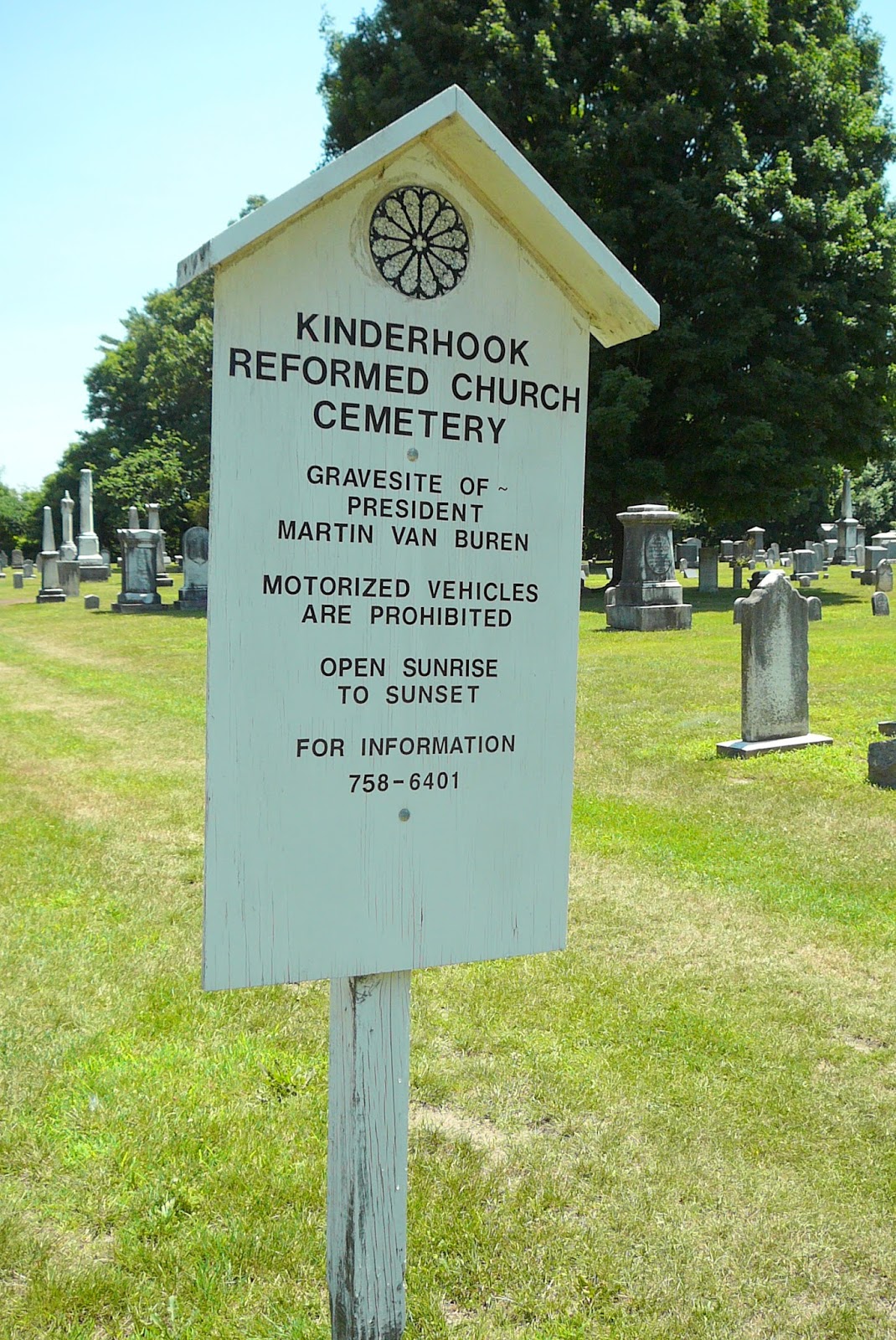
Today's goal was to visit the cemetery in Kinderhook where Van Buren and many dead ancestors (the real ones) reside.  I expected the Kinderhook Reformed Church Cemetery to be co-located with the Kinderhook Reformed Church.  Silly me.  But this lost cemetery (a pattern?) gave me an opportunity to go into the church (open!) and talk to a live human.


The human with whom I spoke was assistant to the pastor, very friendly and generous.  He turned on the lights in the sanctuary just for me to look around.  He told me the history of the church, which has been destroyed and damaged multiple times over its life.  Today's church has a magnificent interior:  beautiful, areligious stained glass windows, glistening organ pipes in a real organ loft, and a soaring ceiling very Dutch in design and feel.

Once I had directions to the cemetery, I asked if the church had ever been located there.  I explained that I had read a story in the Lennox and Addington Archives that Jan Martense and Dirckje Harmense (they died in the 1680s) were buried under the church.  My informant responded with considerable surprise.  He said that bones had been discovered during excavation for one of the church reconstructions.  No one knew whose bones they were, so they were reburied in place under the church.

The cemetery is vast, split into two sections by a country road.  One side is clearly older than the other, so I concentrated my efforts, row by endless row, on the older side.  Probably 80% of the markers are so eroded by time and elements that they are completely illegible.  Lost history, everywhere.  Yet, my visit was productive.  I considered skipping the other side, which was clearly newer.  But with only a brief review, I found that the new side's center section also bore fruit.  Now all I have to do is match up the photos I took with the names I have uncovered for my ancestor tree.  That should keep me busy for a few months!


Reflecting on today's efforts, I realize that, except for the oldest ones, American ancestors don't hold the same excitement for me as the Canadian ones.  Should I have expected that?  Is this simply a reflection of my anti-American-exceptionalism bent?  I think both are worthwhile questions to consider as part of this who-am-I and where-do-I-come-from journey.

Tomorrow I take a break from the search for dead ancestors.  But I'll have lots of stories to share with my friends when I meet up with them in Burlington.  Bernie, here I come!


20 July 2016

Welcome to the U.S.A. - Day 9

The welcoming message came from the GPS voice.

But first I hit the Adolphustown archive as soon as it opened ... only to find their Internet down.  I learned, however, that records are maintained, often on paper, at the office that received the UEL certification request.  But identifying the right office requires the Internet.  Fortunately, I now know "the key" and more about the distributed recordkeeping of the UEL.

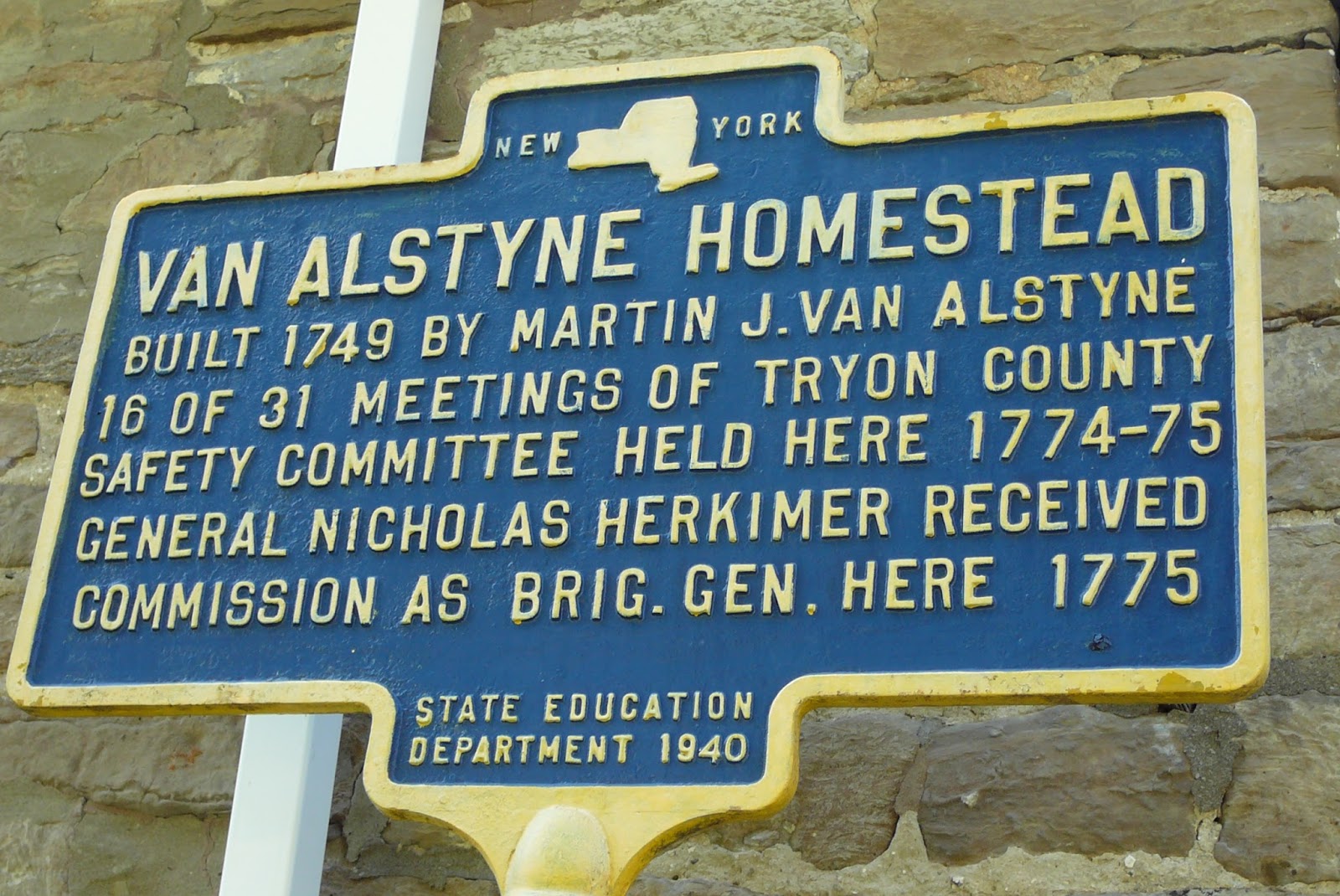
Next stop:  Canajoharie, New York.  That's where the Van Alstyne Homestead still stands.  Surprisingly, it is tucked into a nice residential neighborhood of mostly older homes.  But since it was built in 1749, I guess the neighborhood did the tucking.  The house -- clearly Dutch colonial -- appears from the outside to be in extraordinarily good shape.  It's only open on Saturdays, so exteriors are all I have.


Getting to Canajoharie was a LONG schlep, even with no waiting at the border.  I didn't choose "Ignore Highways" on the GPS machine, but I still ended up traversing New York by backroads.  After all, I was taking a diagonal route, or would have been, if I had been a crow.

I spend multi-hour drives accumulating odd observations:  The grass had not been mowed along most of the country roads, but the grass along the road at Ft. Drum had been shorn like the head of a private entering boot camp.  I ignored the turnoff to Poland, but I drove through Denmark and Lowville.  Lowville -- isn't that somewhere in a Dr. Seuss book?  And you know those round bales of hay encased in plastic that we see back home?  The ones that look like giant marshmallows?  Well, in New York they don't look like marshmallows.  They're still round, but they are yards and yards and yards long, still encased in white plastic.  They look like mammoth, white hay sausages.  Entertaining.  Finally, for safety, the New York State Thruway has created "text stops."  That's right.  Unserviced spots along the Thruway for the sole purpose of pulling off to read or send a text message.

ICYMI today from the CBC:  Canada has just instituted a new policy to provide cash benefits to lift more children out of poverty.  Just imagine that.  Justin Trudeau's government has this notion that income and poverty are related!  With this policy, Canada expects to reduce the child poverty rate from about 11% to less than 7%.   In case you want to compare, the U.S. has a child poverty rate of 22%.  (That U.S. statistic is my addition.  The CBC never mentioned that Canada already has a child poverty rate half that of the U.S.  Before this new policy to do better.)

19 July 2016

Plan Twice Visit Once - Day 8

Ooopsy.  Today was my day to visit Adolphustown, founded by Major Peter Vanalstine, the big kahuna of Loyalists and ancestor extraordinaire, in 1784.  Adolphustown sits on the edge of Lake Ontario with a massive campground (bring your tents and RVs), the Loyalist monument and burying ground (most graves unmarked), and a museum/archive/research centre.  This is the United Empire Loyalists Heritage Centre.  All wonderful things, except the museum/archive is closed on Tuesday.


Entrance to UEL Cemetery


UEL Monument


UEL Museum / Archives

Oops! 

 Although I am leaving Napanee tomorrow for New York, I will do so with a detour through Adolphustown.  I can't miss the archive.  I still have Loyalist ancestors to research!

The day was not lost, however.  I took the Loyalist Parkway along Lake Ontario on my way back to Napanee.  A shocking number of things are named "Loyalist":  Loyalist Township, Loyalist Orchards, Loyalist Country Club, etc. etc.  And Britsh flags fly!  Sometimes in concert with Canadian flags, sometimes alone; never with American flags, of course.  I wish I had counted them on my way from Adolphustown to Bath (yes, Bath).

On my drive today, I marveled at the change in landscape -- I've gone from serious timber country to equally serious farmland.  A trip that began with forests and hills up north has morphed into flat farms sporting massive fields of corn, golden grasses (wheat?), and short, unidentified crops.  My limited knowledge of geology tells me that the northern reaches were carved out by glaciers (evidence all the lakes) and not much grows there, lacking topsoil.  Here, on the other hand, the land has been more gently treated by time and therefore can support agriculture.  At least, that's my story.

Not spending hours in the Adolphustown archive also gave me the opportunity to visit the Lennox and Addington Museum and Archives in Napanee.  I did spend hours there and clarified a few weirdnesses in my ancestor tree.  I also read stories about an impressive ancestor, a woman, Dutch in origin, who was said to have kept bees, represented her spouse in land deals, kept her own account book, and won cases in court, when the need arose.  She emigrated with her spouse and two children from the Netherlands in 1655, so all this occurred in the late 17th/early 18th century--WOW.

Finally, ICYMI, I have to share two of the biggest news stories from the CBC today:  First, Canada is only mentioned once in the Republican platform.  The Republicans are supporting construction of the Keystone pipeline.  That's the only mention of Canada; nothing about building a wall.  (The latter came directly from the reporter's mouth.)  Second, Canada is having a Cover-Oregon style meltdown.  In this case, it is the inaptly named "Phoenix system," which is supposed to process payroll for Federal employees and pensioners.  Except it isn't working.  Hundreds of people are not getting paid and the authorities are scrambling to get payments out, sometimes in cash.  It seems that IT contractors are the same, regardless of which side of the border they're on.