21 September 2019

Meppel, Ancestral Lands

Days 3 and 4 in Meppel. Train from Haarlem to Amsterdam, change to another train to Zwolle, where we would pick up a car. I’ve mentioned before how wondrous the train system is. The only hiccup came when our direct train to Zwolle insisted that it had come to its terminus before Zwolle. Turns out we had to shift cars, not trains, to complete our journey. Had any of us spoken enough Dutch to follow instructions, none of this would have been an issue. I won’t mention the 30-minute walk from Zwolle station to the car rental site. Yes, I will. It was follow the leader, where the leader was equipped with nothing but a downloaded GPS navigator. And faith. I won’t give the Netherlands an A+ for signage anywhere we’ve been. But we made it to the car. It helps when the e-navigator counts down the minutes to destination. The trip north to Meppel gave me more chance to peruse the landscape. Somewhere between Amsterdam and Meppel we saw another IKEA. And this land of canals everywhere is shockingly flat, like the proverbial pancake, or pannenkoek, as the Dutch would say. As far as the eye can see. And green. Very green. The color. There are also a bazillion windmills, the modern kind, between Zwolle and Meppel. Lisa said it reminded her of Indiana. I told her not to insult the Netherlands that way. And more livestock and other farming. Cows, sheep, and lots and lots of horses and ponies of every size. To me, it seemed odd that such a small country with such limited acreage would devote so much of it to horses. When I asked someone in Meppel about the horses, I was told that equestrian sports (jumping) are popular. I would guess this speaks to affluence. In fact, everything I have seen so far suggests affluence and abundance. Or maybe those are the wrong words. I don’t mean that everyone and everything appears rich. Comfortable may be a better term. I haven’t seen any evidence (where I’ve been, admittedly) of grinding poverty. The cows appear quite contented. Or lazy. Frequently lying about in the green grass. And there are all kinds of them: white cows, brown cows, brown and white cows, white and brown cows, and a few “Oreo” cows (chocolate on either end, white in the middle). I last saw Oreo cows in the UK many years ago. The Netherlands, I have learned, is one of the most densely populated countries (perhaps the most densely populated) in Europe. Yet, Drenthe Province, home of Meppel, is quite rural. Meppel itself is a small city, 30,000-ish people. And tidy. Oh, so tidy. I don’t think I saw a speck of trash until we traversed into Germany and then Venlo. I also didn’t see anyone who appeared to be really down on their luck in the parts of the Netherlands we’ve visited. Later on, I saw two people begging and one lady picking through a trash bin, both in Germany. A hotel employee in Meppel confirmed my theory about income disparity or lack thereof. He said paychecks only show net income, not withholding. Taxes start at 30% and go up progressively to 50%. VAT (sales tax) is built into the prices. Health insurance is “required,” is how he put it, so everyone is covered. The roads are smooth, even out in the countryside. Virtually everyone drives bicycles (like maniacs), some drive motor scooters, most cars are tiny and frankly adorable. I can’t translate the price of gas, Euros and liters. Our hybrid rental went everywhere we drove the entire trip on a single tank of gas, which seemed remarkable to me. I kept wondering if we would run out of gas! By the way, if you’ve heard about the Netherlands being the “low country,” it surely is. When I checked the altitude in my second story hotel room, I found I was 10 feet above sea level. And there are canals everywhere. I didn’t really learn much about my ancestors in Meppel. Everyone I spoke with — at the public library, at the Oud Meppel (Old Meppel) historical society, at the 15th century church (De Grote of Maria Kerk) — responded with “Whoa, that was a long time ago!” when I told them ancestor-2 emigrated in 1655 and I have reason to believe his father and mother remained behind. I did learn that everyone I spoke with was incredibly kind, tried their utmost to be helpful, and shifted seamlessly between Dutch and English, a feat this uneducated American can only admire and envy. I spent a lot of time apologizing for only speaking English. (Why do we do this?) One theory of history percolated forth, however. When ancestor-2 emigrated, he and spouse carried no surname with them. Surnames simply hadn’t been invented yet in this part of the world. The surname once acquired became VanAlstine, or VanAlstyne, or VanAelstyn, or VanAlstijne, or variations thereof. So, how did the name, apparently acquired in America, transfer back? I have found one Dutch record with VanAlstijne, so some transfer apparently occurred. Regardless, I have read that the name means high stone or old stone (oud steen).

Here’s my weird hypothesis.  How could this happen? There are almost no stones in the Netherlands!  But up north in Drenthe there are Hunebed, ancient gravesites assembled by [somehow] stacking massive boulders left there by the glaciers.  (Virtually all the other soil we saw up there was sand.). The Hunebed (there are about 54 of them, they’re numbered) were built about 3000 years ago.  Two, D53 and D54, are quite near Meppel and each other.  Perhaps that is the source of the oud steen?  I’ll probably never know for sure.  But it makes for a really good theory and something to research.

D53 & D54, very close to Meppel

The other thing to know is that the Germans disassembled D53 during WW2 in order to build an airfield.  Flat site with a handy dune next to it to survey the landscape. To do this, they just moved the boulders aside and left them.  After the war, using pre-war photographs as a construction guide, the Dutch dug out the boulders and reassembled the Hunebed exactly as it had been before.  They reassembled some of their prehistory! So much of that had to be done. Virtually every church we saw was damaged, some all but obliterated, during the war.  And then they rebuilt. Here’s what it looks like today ...
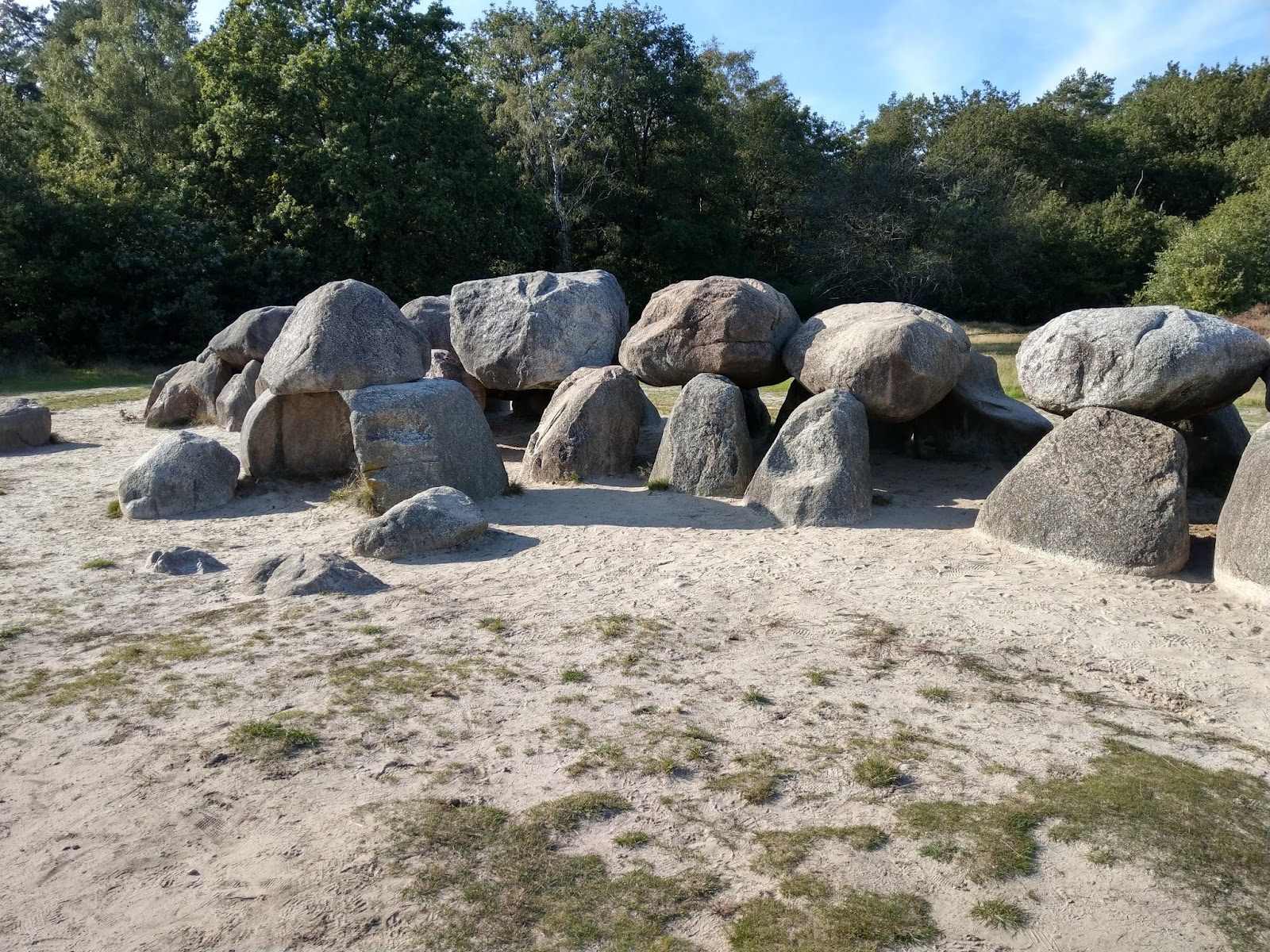

D53, rebuilt after WW2

A few more things about Meppel.  The town center is quite dense, and the buildings — commercial and residential — are fairly tightly packed.  The houses are all very similar in style, nearly all red brick with sharply peaked red tile roofs. Virtually impossible to tell how old (or new) they are.  We saw two, count ‘em two, very modern looking houses out in the countryside on the way to visit the Hunebed. Despite their modernity — not brick and with different window styles — they were shaped exactly the same as all the other, traditional houses.  The homogeneity of housing design is surprisingly pleasant, not boring at all. And plants! Everyone seems to have a thing for plants. Windows full of house plants, tiny gardens with glorious heterogeneity of plant content and style. And the streets and sidewalks are all brick and cobblestones, perfectly kept.

My first contact with an old style wooden windmill (molen) was beside the Oud Meppel building. Because our weekend in Meppel coincided with the annual Open Monuments event (2 days), many heritage sites were open and FREE. The mill and the old church were among these sites. The mill has been recently renovated — think timberframe assembled with wooden pegs — and there are plans to begin grinding mustard, once they acquire and install a grinding stone. We were able to climb up to the windmill deck and from inside up into the second floor. There you could look out, up the canal and over the whole town, and see the reverse side of the arms as they came flying (literally) past the open window. On the main level they had little sample jars of mustard from another city, which I was not going to buy. However, when I told the mill-keeper I was a fan of French mustard and had no experience with Dutch mustard, he insisted I take home two little jars (TSA-approved size), gratis. Nice people.
At the conclusion of our trip, Lisa and I agreed that Meppel won the award for most quaint town we visited. Such a lovely little place, good food, friendly people. I hope to do some more research and return one day.

14 September 2019

Old Haarlem & Amsterdam

Day 1

Our hotel, the Amadeus, was right there hiding in plain sight.  On the square, within spitting distance of the church with the massive organ where Mozart once played.  History surrounds me.

Following TripAdvisor’s advice, lunch was “the best frites in Haarlem.”  Not sure the label fits, but the frites were freshly fried, served in a traditional paper cone for takeaway.  I opted for mayo (rich and oddly sweet) in lieu of ketchup.  When in Haarlem, eh?

Lost the afternoon to a nap.  Dinner was an authentic Dutch place, Balletje, known for its meatballs.  Imagine an oven-ready personal casserole containing a massive meatball (beef, chicken, or veggie), choice of sauce (Dutch gravy for me), atop a choice of potato with mix-ins (red cabbage + crispy diced apple for me).  Comfort food, filling.  The beer also a bit unusual.  Trappist brew, mildly brown, also just a touch sweet.

Day 2 — Amsterdam after breakfast.

I had a short list of things to see in Amsterdam.  Go by (somewhat ambivalent about going in) the Anne Frank house (huis).  Visit the Homomonument, a monument to long-persecuted LGBT people.  Visit the West India House (West-Indisch Huis) where the Dutch West India Company decided in 1625 to establish New Amsterdam.  At least one of my DNA ancestors worked for the WIC before their bankruptcy or near-bankruptcy.  He decided to emigrate with his family to New Amsterdam in 1655.

We found the Anne Frank house surrounded by a mob of people.  The Homomonument was less populated, partly because it is so well hidden albeit right out in the open on a square on a busy corner by a canal.

No one was at the West-Indisch Huis.  The exterior walls appear contemporary but I barged through some open doors into an inner courtyard and found the exterior walls of the old building, the surprisingly petite statue of Peter Stuyvesant (erstwhile Governor of New Amsterdam), and a sweet plaque commemorating American-Netherlands collaboration in renovating and preserving the old building.  It is still in use, housing, among other things, the John Adams Institute.

After much walking, canal peaking, and narrowly averted bicycle crashes, we returned to Haarlem in late afternoon.

A note about public transport is in order here.  Sigh.

Would that the U.S. had even a fraction of the transport options that exist in Europe.  We took an easy (every 6 minutes easy) bus from the airport to Haarlem.  One thing that made it so efficient was that it appeared to operate on a dedicated roadway (busway?) that ran parallel to the autoway.  In places where it crossed dedicated bikeways, railroad-style arms came down to block the bicyclists’ path from the bus.

To get from Haarlem to Amsterdam we took a train, a “Sprinter,” which inexplicably is a tiny bit slower than the “Intercity” line.  Regardless, it’s a 15-20 minute trip.  Through lovely green countryside, horses, cows, sheep, and one IKEA.

On the other hand, navigation within cities is difficult.  Old, old street systems resemble spaghetti in their curvature and interweavings.  But we got there, every time ... eventually.

The big 16th century church in Haarlem.

I’m not much one for churches, but this one has some interesting features.  A massive, massive organ — pipes reaching 30 meters high.  When I arrived, someone was playing bits and pieces.  They may have been practicing.  I hung around simply hoping that they would play something start to finish.  Never happened.

Except for the wooden portion in the middle, the floor is paved with grave markers, front to back.  Some of the stained glass is very simple, with panes in geometric patterns.  The most recent edition (2000s) is very modern but beautiful and takes nothing away from the old.  The vaulted ceiling is wood, except for the intersection of the transept (? never sure about these churchy terms).  That part is gloriously, but simply, painted.

Impressions

This country has a bazillion bicycles, and not a few motorbikes.  I can’t imagine trying to negotiate a roadway within a large city in this country by any conveyance navigated by me.  See spaghetti, above.  Bicycles come plain, with front-facing boxes, with boxes with tents, with all sorts of boxes actually.  Many are wooden, a few plastic.  The Dutch have been very inventive in their designs for bicycles that will carry a variety of things, from children to inanimate cargo.  I don’t think I ever saw a single bike with a child on the rear, American-style.

Even that which is old looks shockingly new in these two Dutch cities.  Everything just appears to be in such good repair, and that which is not appears to be undergoing renovation.  I guess that’s how you keep history going.

Amsterdam, especially, is crowded.  Very, very crowded.  I’ll blame the tourists.  I’ve been to New York, San Francisco, London (many times), and Paris.  I don’t think I've ever been in a city that rivals Amsterdam for crowded.  That was unexpected.  I wonder what it’s like during winter?


23 March 2018

To Disarm the Mountaineer

The mascot for West Virginia University, my alma mater, is the Mountaineer.  The Mountaineer is recognizable by his or her buckskin clothing, coonskin cap, and ever-present rifle.  Yes, a rifle.  A rifle that is periodically fired, outdoors or in.  But this is a percussion rifle, which requires a measured dose of powder for each report, and no bullets are involved.  Otherwise, the Coliseum roof would be very leaky.

I recognize the cultural and historical significance, of the entire costume.  Nonetheless, I ask myself if the rifle continues to be a good idea.  I ask myself that question.  Really.

I believe in common sense gun regulation that includes removing guns from places they do not belong and from people who should not have them.  And I believe that symbols matter.  I believe, for example, that statues of  Confederate “heroes” should be taken down because they honor white supremacy.  I believe the Germans got it right after World War II when Nazi symbols were banned.  Frankly, I believe the Confederate flag should be banned ... but our Constitution says no, and I believe in the Constitution more.  (Perhaps I’ll write another day about how I think the Confederate flag qualifies as hate speech.)

Is the gun-toting Mountaineer any different?  Should the 21st Century Mountaineer be disarmed?

My conclusion (so far) is that the Mountaineer is different.  Each time that rifle goes off, I am reminded how essentially different it is from modern weapons.  Shoot-once-then-reload rifles were used during the American Revolution.  Thus, the Mountaineer’s rifle is more akin to the type of weapon the Founders had in mind when they wrote the 2nd Amendment to the Constitution.  Perhaps that is a good reminder.  Perhaps that is the better symbol.

Is that just a rationalization?  I'll keep asking those pesky questions.

Don’t get me started on the Oregon State chainsaw and its symbolism.


09 March 2018

Growing Up Union

For some of us, it is hard to fathom that the recent strike of public school teachers from all 55 counties of West Virginia was officially a "wildcat" strike.  Wildcat means a strike of workers without a union, without collective bargaining rights, without the right to strike.  All of them could have been fired for walking off the job; they all put their livelihoods on the line.

This is an old story in West Virginia, going back to the coal fields.  And it is a story that has stimulated a particular set of memories from my childhood.

My dad was born in 1909 (or 1910; he had no birth certificate).  He left school after eighth grade (or sixth grade, says the 1940 Census).  Whether he went directly to work in the coal mines is hidden in undocumented history.  I do know that, following some period of working in the mines, he travelled the country as a hobo, riding the rails (hopping freight trains for transport), living in homeless camps, taking on jobs that presented themselves, surviving as best he could.  He travelled the entire country, every state but Arizona, he said.  Based on his stories, he was still a kid, not legally an adult.  One means of survival, he said, was to try to enlist in the army, which would provide room and board while officials sought his parents’ permission (because he was underage).  For whatever reason, his parents never consented.  Decades later, when telling this story, he always seemed wistful, as though considering how different his life might have been had he been granted that modicum of parental support.

Eventually, he made his way back home to West Virginia.  A marriage followed in 1930, and shortly thereafter his occupation is listed as "coal loader" in the 1930 Census.  I take that to mean working underground, in a deep mine, breathing in coal dust with every exertion.  But then, the 1940 Census and his World War II draft registration card say "unemployed," an unexceptional fact during the Great Depression.  That may have saved his life; my dad didn't work in the mines long enough to get black lung or to be crushed in a mine explosion.

I didn't grow up in a part of West Virginia that had coal mines.  But I'm sure I learned about company towns and company stores and being paid in scrip that was only accepted in company stores from my father's stories.  The "company" here is the coal company, the employer who controlled everything and wanted to keep it that way.  Union organizing was a serious and often deadly business in West Virginia during the early 20th century, my dad's time.  But then so was coal mining, then and thereafter.

Another of Daddy's stories was his chance meeting with John L. Lewis, the powerful President of the United Mine Workers union.  During WWII, Daddy was working at a service station (the Army had turned him down again, this time because of a heart murmur) where, one day, John L. Lewis stopped for gas.  It was the story of an ordinary person who had met a celebrity.

When I was a little girl (1950s, early 1960s), my dad was a truck driver, a member of the Teamsters Union.  Yes, this coincides with the time when the Teamsters were starting to engage in criminal activity.  But in our house, being a Teamster was a big deal.  Actually, unions were a big deal.

Many kids play cards.  I did too, but my deck of cards didn't have hearts, diamonds, spades, and clubs.  I didn’t have flash cards to learn my letters, numbers, or sight words.  My flash cards displayed symbols of the trade unions -- Teamsters, boilermakers, electricians, carpenters, bricklayers, and on and on.  The game I played with my dad was "name the trade union," based on the logo on the card.  It was a challenge; I got pretty good at it.

And even though I didn't grow up near the coal fields, you can't grow up in West Virginia without feeling the impact of coal.  I recall watching the news following deadly mine explosions that left no survivors except devastated families.  I grew up listening to Tennessee Ernie Ford sing Sixteen Tons, the sad story of a coal miner who can't even afford to die because he is so far in debt to his employer.  After all these years, I still remember the lyrics.

Sixteen Tons is a far cry from Country Roads, today's uplifting anthem of West Virginia.  Teachers standing up for their rights at the West Virginia capitol sang County Roads with passion and ferocity.  All standing together singing without union protections, 55 Strong.  That's today's union story.  Some things have changed; others have not.


21 August 2017

Berkeley and I Conduct a Science Experiment

I wasn't enamored of the eclipse or, especially, of all the hype surrounding it.  I was also concerned about eye safety, what with so many eclipse glasses being recalled.  My plan was simply to watch online, but all the live streams turned out to be disappointing.

Therefore, I decided to do my own mini science experiment.  As the appointed time approached, Berkeley and I went outside and sat on the porch, no glasses, but to *feel* what it was like.

As dusk approached, the neighborhood became exceedingly still, then a breeze picked up.  When it became dark, the breeze stopped, the temperature dropped instantly to chilly, and the streetlights came on.  Totality (I presume, since I wasn't watching) was marked by the utter silence turning to cheers from the park nearby.  As it became light again, the entire process reversed:  temperature up, breeze on, streetlights off.

Someone asked me yesterday how Berkeley might react.  In fact, my canine co-investigator could not have cared less.  But I can now understand better why civilizations that came before us might have been ... confused.


Photo by Chris Becerra, the best photographer in Oregon.


13 August 2017

Owning History

German students spend a part of each year studying the horrors of Nazi Germany.  All students must visit at least one former concentration camp to be reminded that the stories of the Holocaust were not only real but happened nearby.  [http://www.mcclatchydc.com/news/nation-world/world/article29557972.html).

We do nothing like this.

Nazi symbols were outlawed in Germany.  Even the use of Nazi symbols for anti-Nazi purposes has been deemed intolerable.  A German judge, ruling against the use of Nazi symbols in anti-Nazi paraphernalia, stated:  "The danger of familiarization is ever present."[http://www.slate.com/blogs/the_slatest/2015/06/24/germany_banned_its_ugly_historic_symbols_should_we_do_that_too.html]

We do nothing like this.

Instead, in the U.S., symbols of the Confederacy remain and serve every day as the visual rallying cry for white supremacy and racism.  They are shielded by our blessed First Amendment.  They are so familiar that most people accept them as innocuous and normal.  We are the victims of that familiarization the German judge warned about.  In fact, we are so brain-washed that most of us don't even recognize it.

There is more.

There was virtually no accountability for Confederate Civil War leaders.  Reconstruction was short lived and followed by the rise of the KKK, Jim Crow segregation, and now mass incarceration. An alternative history was constructed, whereby the Civil War is unrelated to slavery, unrelated to treason.  Confederate generals became and remain martyrs for the "lost cause."  After the war, Confederate officials and generals, perpetrators of the treason, were permitted to resume their lives, and amnesty and pardon policies were issued before the 1860s ended.  There were no trials for treason. Compensation was ultimately provided for the Lee family for the plantation that had been seized and converted to Arlington National Cemetery.  A building at West Point bears Lee's name.  Those are only a few examples.

Our history is not just about the inhumane horrors of slavery.  It is also about genocide.  Systematic.  State-sanctioned.  Genocide.  A portrait of Andrew Jackson, the President most cravenly associated with the Indian Removal Act and its resultant genocide, now resides on our $20 bill and, since January 2017, hangs on the wall in the Oval Office in the White House.  Manifest destiny, which robbed indigenous peoples of their lands and lives, was perpetrated under the Stars and Stripes.

We have yet to own either of the original sins of the United States:  slavery (and its associated racism) or genocide.  Public policies continue to support racism and generate or sustain racist outcomes; treaties with Native American tribes continue to be broken.  Manifest destiny is alive and well but has extended beyond its original Atlantic-Pacific reach to encompass the world.

All these thoughts came rushing in as a result of the weekend's deadly march in Charlottesville.  Let us not forget its purpose:  preservation of Confederate iconography and white supremacy through terror.

Isn't it ironic that the torch-lit march ended at the statue of Thomas Jefferson on the University of Virginia campus?  Or was it irony?  Can something so fitting be called irony?

In our history lessons, Thomas Jefferson is venerated as Founding Father, author of stirring words in the Declaration of Independence, father of the University of Virginia, President.  But Thomas Jefferson never lived those stirring words he wrote, that "all men are created equal."  He was a slaveholder.  He was a rapist.  In politics, he demonstrated repeatedly his willingness to win at any and all costs.  He was a liar.  He was a hypocrite.

Slavery, genocide, founding fathers who raped their slaves.  This is not the history we are taught.  We do not own our history.  And we continue to pay the price for it.


15 June 2017

Supply and Demand

We have a housing crisis in Corvallis, in fact, in all of Oregon, but my focus is on Corvallis because that's where I live.  The dirty little secret is that Oregon's unique and acclaimed land use system is partly at fault.  Yet, I recently submitted an application for a seat on the local Planning Commission in the faint hope of being able to nudge public policy in a different direction.

The current land use planning system all began with Senate Bill (SB) 100, which passed the Oregon Legislature in 1973.  Oregon's beloved environmentalist then-Governor Tom McCall gets the lion's share of credit.

Based on the finding that "uncoordinated" land use posed a threat to the State and its people, SB 100 established a complex framework of requirements to guide all future development "to assure the highest possible level of liveability [sic] in Oregon."  The law established policy making and administrative bodies at the State level.  The framework mandated that each city and county establish comprehensive plans, with regular review and revision, and component structures -- zoning, ordinances, regulations -- were required to conform to statewide planning goals, which now number 19.  Extensive public participation in the development of goals and guidelines was mandated in great specificity within the statute itself; and public involvement is now enshrined as Planning Goal 1.

What could possibly go wrong?

The Corvallis Comprehensive Plan, which was last revised in 1998, is replete with contradictions and based on what we now know are seriously flawed assumptions.  Among the more laughable of the assumptions are these two:
  • "Oregon State University enrollment is expected to stabilize or grow slowly over the next 20 years, and Hewlett Packard is not planning any major expansions."
  • "Rental housing will remain affordable compared to the rest of the State."
Since adoption of the plan nearly 20 years ago, reality has deviated radically:  OSU enrollment has more than doubled, HP employment has dropped as a stone succumbs to gravity, and Corvallis rental housing is some of the most unaffordable in the State.

None of these assumptions was revised when the Housing article of the Comprehensive Plan was amended in 2016.  In other words, the plan today is essentially the same plan as that adopted in 1998, despite vast changes in local circumstances.

Comprehensive Plans are developed from a broad, inclusive "visioning" process.  Unfortunately, such processes tend to be neither broad nor inclusive.  I've just recently observed one of these processes in action.  Consider which segments of the population actually turn out for community"visioning" activities:  those with discretionary time and income.  

The following is one inexplicable Vision statement cited in the Housing Article of the Corvallis Comprehensive Plan of 1998:
  • "Development standards have been created based on the characteristics of traditional Corvallis neighborhoods."
In other words, development standards were designed to maintain the status quo.  To confirm this, read the Corvallis Land Development Code (LDC).  Or simply weigh it:  in print, it is a 1017-page brick.

Of course, as a practical matter, the status quo is fine if you do not expect anything to change (as anticipated by the assumptions underlying the Corvallis plan).

In the interests of full disclosure, I mentioned most of these observations in my interview with the City Council to become a Planning Commissioner.  I even referred explicitly to "the mess we're in" with respect to our lack of affordable housing.

But there are numerous other contradictions between talk and action within the Corvallis Comprehensive Plan.  It cites "Findings" (defined as "facts") that express support for:
  • New buildings on smaller lots to add to the diversity of housing types;
  • Variation in lot dimensions to vary housing types to lead to greater market choice;
  • Promotion of diverse housing types;
  • A mix of housing types and costs to promote diversity in household types, ages, and incomes;
  • Compact development.
All that appears downright forward thinking.  Yet, in the same section these are effectively contravened by ambiguous references to:
  • "Compatibility" between buildings in compact developments;
  • Mitigation of "compatibility" problems;
  • "Compatible" development using design features.
Diverse yet compatible.  Novel yet traditional.  Square yet circular?

These illustrate another problem that arises in Corvallis on a regular basis:  the regulatory reliance on ambiguous notions such as "compatible" and "similar" when the law provides only for clear and objective standards.  But that is enough of a topic for a whole separate blog entry.

However, this leads us back to livability, the purpose of SB 100.  "Livability" is probably the most over-cited reason for no-growth, no-change, no-development, no-no-no-no in Corvallis.  I have come to be physically repulsed whenever I hear the term.  And it comes up a lot, always in response to change.

In Corvallis, "livability" is code for preserving the status quo, repealing the law of supply and demand, repudiating the value of diversity under a veil of privilege.

Why do I want this job?  When did this practical, pragmatic one become so quixotic?

Postscript:
Despite all my disclosures, including my personal critiques of the way things are, they still selected me to serve.  Oh, my.  Whatever does THAT mean?